Category: Evolve

  • Why Every Home Should Use an Appliance Protection Plug

    Why Every Home Should Use an Appliance Protection Plug

    I used to think surge protectors were one of those “nice to have” purchases, right up there with a fancy doormat or a second set of coasters. Then a storm rolled through my neighborhood a couple of summers ago, knocked out power for about four seconds, and when it came back on, my refrigerator made a noise I’d never heard before and never want to hear again. The repair guy took one look at the compressor board and said the same thing he apparently says all the time: “Yeah, that’s a power spike. Happens more than people think.”

    That was the moment an Appliance Protection Plug stopped being an accessory in my mind and started being basic home maintenance, right up there with changing air filters or testing smoke detectors.

    What Is an Appliance Protection Plug, Actually?

    An Appliance Protection Plug is a small device, sometimes a single plug, sometimes a compact box, that sits between your outlet and your appliance. Its whole job is to watch the voltage coming through your wiring and intercept anything that spikes above what your appliance is built to handle. When it senses a surge, it diverts that extra energy away before it ever reaches the sensitive electronics inside your fridge, washer, or HVAC system.

    It’s not the same as a basic power strip. A power strip just gives you more outlets. An Appliance Protection Plug is doing active work every second it’s plugged in, standing guard against the electrical equivalent of a wave crashing over a seawall.

    Power Surges Happen More Often Than You’d Guess

    Most people picture lightning when they hear “power surge,” and sure, that’s one cause. But the truth is, the biggest threats to your appliances are way less dramatic:

    • The power grid is switching or rebalancing the load
    • A neighbor’s air conditioner or well pump kicking on
    • Utility company equipment is resetting after an outage
    • Even your own appliances are cycling on and off internally

    None of these show up as a dramatic flash of light. They’re small, quiet spikes that happen dozens of times a month, and every single one puts a little bit of wear on the delicate circuit boards that now run almost everything in a modern home. This is exactly the kind of everyday wear an Appliance Protection Plug is designed to catch before it becomes a real problem.

    Today’s Appliances Are More Fragile Than You Think

    Here’s the part that surprised me the most once I started paying attention. Appliances used to be mostly mechanical, with motors, coils, and simple switches. Now, even a basic dishwasher has a circuit board managing its cycles. Refrigerators have digital displays and sensors. Washers have microprocessors that fine-tune water levels and spin speed.

    All that computing power makes appliances smarter and more efficient, but it also makes them a lot more sensitive to electrical inconsistency. A machine built in 1995 could shrug off a small power fluctuation without blinking. A machine built in 2026 might throw an error code, reset itself, or, in worst cases, fry a component that costs more to replace than the plug that would’ve prevented it.

    A Small Device, A Big Difference

    What makes an Appliance Protection Plug so worthwhile isn’t just what it prevents; it’s how little effort it asks of you in return. You install it once, and from that point on, it’s simply there, working quietly in the background every time your appliance is plugged in.

    Compare that to the alternative: a fried circuit board, a service call, a wait for parts, and an appliance sitting unusable in the meantime. A repair like that disrupts your whole routine, whether it’s a fridge full of groceries or a washer you needed yesterday. An Appliance Protection Plug simply removes that disruption from the equation before it ever has a chance to start.

    It’s Peace of Mind You Don’t Notice Until You Need It

    The strange thing about an Appliance Protection Plug is that when it’s working, absolutely nothing happens. No noise, no flashing lights, nothing to brag about at a dinner party. The reward is simply that your appliances keep running the way they’re supposed to.

    That’s honestly the best kind of home investment, the kind you forget is there until the day it saves you from an inconvenient, expensive surprise.

    A Small Habit With a Big Payoff

    If I’m being honest, adding these plugs to my major appliances took maybe twenty minutes total. Fridge, washer, dryer, the unit that runs my home office equipment, done. It’s not a project. It’s not a renovation. It’s closer to buying good tires for your car: unglamorous, easy to put off, and genuinely worth doing before you need them rather than after.

    So if you’ve been putting it off, or didn’t even know this was a thing you should be thinking about, consider this your nudge. Your appliances do a lot of quiet, unappreciated work keeping your home running. An Appliance Protection Plug is a small way of returning the favor.

  • Why Your EV Needs a Protector This Monsoon Season, And What Happens If It Doesn’t Have One

    Why Your EV Needs a Protector This Monsoon Season, And What Happens If It Doesn’t Have One

    You made the switch to an electric vehicle. No fuel queues, no rising petrol prices, lower running costs, and a cleaner conscience. It made sense then, and it still makes sense now.

    But here’s something most EV owners don’t think about until it’s too late: the most dangerous moment for your electric vehicle isn’t on the road. It’s at home, plugged into a charging socket, during a monsoon evening.

    That’s when every risk in the electrical supply, voltage spikes from storm-related grid tripping, earth leakage from wet walls and flooded cable ducts, neutral failures that distort supply voltage, power surges when electricity returns after an outage, all converge on one point: the cable connected to your vehicle’s battery.

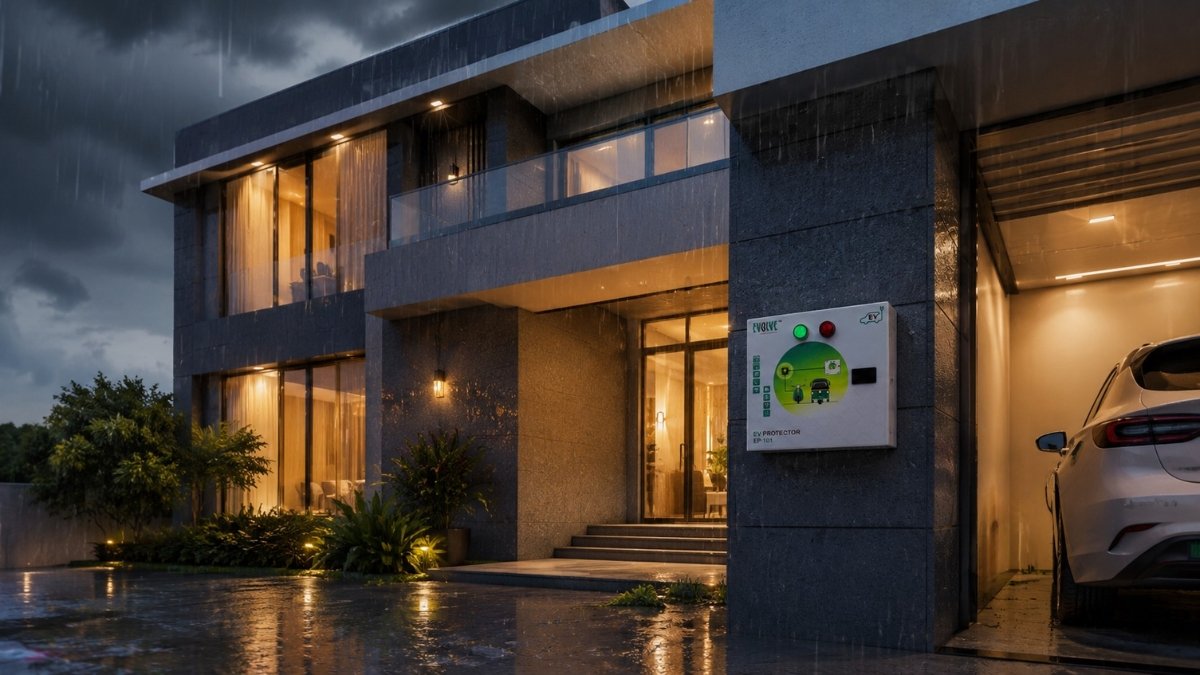
    India’s monsoon season and EV charging are a combination that deserves far more attention than it typically gets. And the Evolve EP 101 EV Protector is designed specifically to address it.

    The Monsoon Charging Problem Nobody Warns You About

    When you charge your EV at home, you’re doing something that sounds simple: plugging a cable into a socket. But what’s actually happening is that your vehicle’s onboard charger is pulling several kilowatts of power continuously, sometimes for 4 to 8 hours overnight, while the vehicle sits stationary and unattended.

    During that window, the quality of the power coming from your wall socket matters enormously. And during monsoon, that quality degrades in ways that are invisible to you but very real to your vehicle’s charging system.

    Voltage surges during storm tripping: Every time lightning strikes near a transmission line or a feeder trips under storm load, the sudden restoration of power comes with a voltage spike. If your EV is connected and charging, that spike travels straight to the charger.

    Earth leakage from wet conditions: Monsoon saturates walls, floors, and cable ducts with moisture. This creates leakage paths for current that wouldn’t exist in dry conditions. In a wet electrical environment, earth leakage becomes a genuine shock risk to the person plugging or unplugging the charger and a stress condition for the vehicle’s charging circuit.

    Neutral failure: When the neutral wire in a supply circuit fails or develops high resistance, common in aging Indian residential wiring exposed to repeated moisture, the phase-to-neutral voltage can swing dangerously. Appliances and chargers connected to a failed neutral supply face severely distorted voltage conditions.

    Overvoltage after power restoration: After a monsoon power cut, when electricity returns, it frequently comes back with a brief overvoltage condition before the grid stabilises. An EV charger that was left connected during the outage receives this spike directly on reconnection.

    None of these events is unusual during an Indian monsoon. All of them represent real risks to an EV charging system and to the person using it.

    What’s at Stake: Your Vehicle, Your Charger, and Your Safety

    An electric vehicle represents a significant investment. The battery pack alone, the component most vulnerable to charging-related damage, can cost anywhere from ₹1.5 lakh to ₹5 lakh or more, depending on the vehicle, and is typically not covered under standard warranty for damage caused by external power quality issues.

    The onboard charger (OBC), the unit inside the vehicle that converts the AC supply to DC to charge the battery, is equally sensitive. Sustained overvoltage or surge events can damage the OBC’s power conversion circuitry. Replacement costs are high, and lead times from service centres can run to weeks.

    Beyond the vehicle and the charger, there’s personal safety. Earth leakage from a wet charging environment, combined with a live connector, is a shock hazard. It’s not theoretical; it’s the kind of risk that proper electrical protection is specifically designed to eliminate.

    What the Evolve EP 101 EV Protector Does

    The Evolve EP 101 is a purpose-built EV Protector, not a generic surge strip or a repurposed appliance protector, but a device designed specifically for the protection requirements of EV charging environments, including commercial EV charging stations.

    Here’s exactly what it protects against:

    Surge Protection

    Every power surge, whether from storm-related grid events, lightning-induced spikes, or equipment switching on the local feeder, is intercepted before it reaches the vehicle’s charging port. The EP 101 clamps the surge and prevents it from propagating into the OBC or battery management system.

    For monsoon season specifically, this is the feature that matters every single night. Storms don’t announce themselves. A surge protector that’s inline between the wall socket and the charging cable is protection that works whether you’re awake and watching or asleep.

    Overvoltage Protection

    The EP 101 monitors incoming voltage continuously and disconnects the charging supply if the voltage rises above safe limits. Overvoltage during a post-outage restoration event, exactly the scenario that happens repeatedly during the monsoon, is caught and blocked before the charger sees it.

    This protection also extends to gradual overvoltage conditions, when the supply in your area consistently runs high during low-load hours late at night, which is exactly when most people charge their vehicles.

    Neutral Failure Protection

    This is a protection feature that very few people know to ask about, and almost no generic protector provides. When neutral failure occurs, the supply to the charger becomes dangerously distorted, and single-phase voltage can effectively double in some neutral failure configurations. The EP 101 detects neutral failure and disconnects the charging supply, protecting both the vehicle and the wiring from a condition that’s particularly common in Indian residential circuits during the monsoon, when moisture accelerates corrosion in older neutral connections.

    Earth Leakage Protection

    Wet conditions during the monsoon create leakage paths. The EP 101’s earth leakage protection detects abnormal current flows to earth, the signature of a leakage condition, and disconnects the supply. This is direct protection against the shock hazard created by charging in environments that have been exposed to moisture, flooded cable runs, or compromised insulation.

    Comprehensive Safety for Commercial EV Charging

    The EP 101 is designed with commercial EV charging station reliability in mind, meaning it’s built for environments where multiple charging events happen daily, where the equipment is expected to operate unattended and without intervention, and where the consequences of a protection failure are significant. For home users, this means you’re getting commercial-grade protection rather than a consumer-grade approximation of it.

    Monsoon Charging: A Scenario That Plays Out Every Season

    Let’s walk through what a protected vs unprotected charging night looks like during a typical Indian monsoon evening.

    8:30 PM, you plug in your EV to charge overnight. A thunderstorm is building.

    10:15 PM, the storm intensifies. A nearby feeder trips under a lightning strike load. Power goes out in your area.

    10:47 PM, Power is restored. The restoration comes with a brief overvoltage spike of 280V before the grid stabilises to normal.

    Without the EP 101, that 280V spike hits your vehicle’s OBC directly. The OBC’s protection circuitry may or may not catch it. If it doesn’t, or if it catches it but the spike was severe enough, the OBC absorbs the damage. You wake up to a vehicle that won’t charge and a service centre visit that will take your vehicle out of commission for days.

    With the EP 101, the EP 101 detects the overvoltage condition on power restoration and holds the charging circuit open until voltage stabilises within safe limits. Your vehicle sees clean, safe power when charging resumes. You wake up to a fully charged battery and nothing to report.

    That’s not a hypothetical scenario. It’s what happens on hundreds of monsoon nights across India every year. The only variable is whether your charging setup has the protection to handle it.

    Who Needs the Evolve EP 101?

    The EP 101 is relevant for anyone charging an EV in India, but it’s particularly important for:

    Home EV owners in areas with frequent monsoon power cuts, voltage fluctuations, or aging residential wiring. If your neighbourhood experiences regular outages during storms, your charging setup needs this level of protection.

    EV owners in coastal areas of Tamil Nadu, Kerala, Andhra Pradesh, and Maharashtra’s coastline, where humidity is high year-round and salt air accelerates insulation degradation, creating earth leakage risk even outside the monsoon season.

    Commercial EV charging station operators who need reliable, uninterrupted protection across multiple charging points with no manual intervention. The EP 101’s commercial-grade design is built for exactly this context.

    Anyone who charges overnight, which is most EV owners. Overnight charging means 6–8 hours of unattended connection during the exact hours when post-storm grid conditions are most unpredictable.

    The EV Investment Deserves EV-Grade Protection

    India’s EV market is growing rapidly. Two-wheelers, three-wheelers, cars, commercial vehicles, and electric powertrains are becoming standard across every segment. But the infrastructure conversation has focused heavily on range, charging speeds, and battery technology, and not nearly enough on the power quality at the charging point.

    Your vehicle’s onboard charger and battery management system are sophisticated electronics. They’re designed with tolerance ranges for input power quality. What they’re not designed to do is absorb unlimited abuse from a poor-quality grid supply during a monsoon storm.

    Surge protection, overvoltage protection, neutral failure detection, and earth leakage protection aren’t optional extras for EV charging. They’re the baseline protection that every EV charging point should have.

    The Evolve EP 101 puts all four in a single device, designed specifically for the Indian grid and the Indian monsoon.

    Charge confidently. Every night. Every season.

  • What Is Dry Run Protection and Why Every Borewell Owner Needs It?

    What Is Dry Run Protection and Why Every Borewell Owner Needs It?

    Picture this. It’s the middle of May. The summer has been long, the groundwater table has dropped, and you’ve been running your borewell pump a little longer than usual each morning just to fill the overhead tank. One day, you switch on the pump, hear it start up, and walk away. Thirty minutes later, you check the tap, but nothing. You go back to the motor. It’s silent. The thermal cutout has tripped, or worse, it hasn’t, and the motor has been running dry for the last half hour.

    You call the pump service technician. He takes one look and says, “Motor burnt. Winding gone.”

    That’s not a freak accident. It’s one of the most common and most preventable pump failures in India. And the device that prevents it is called Dry Run Protection.

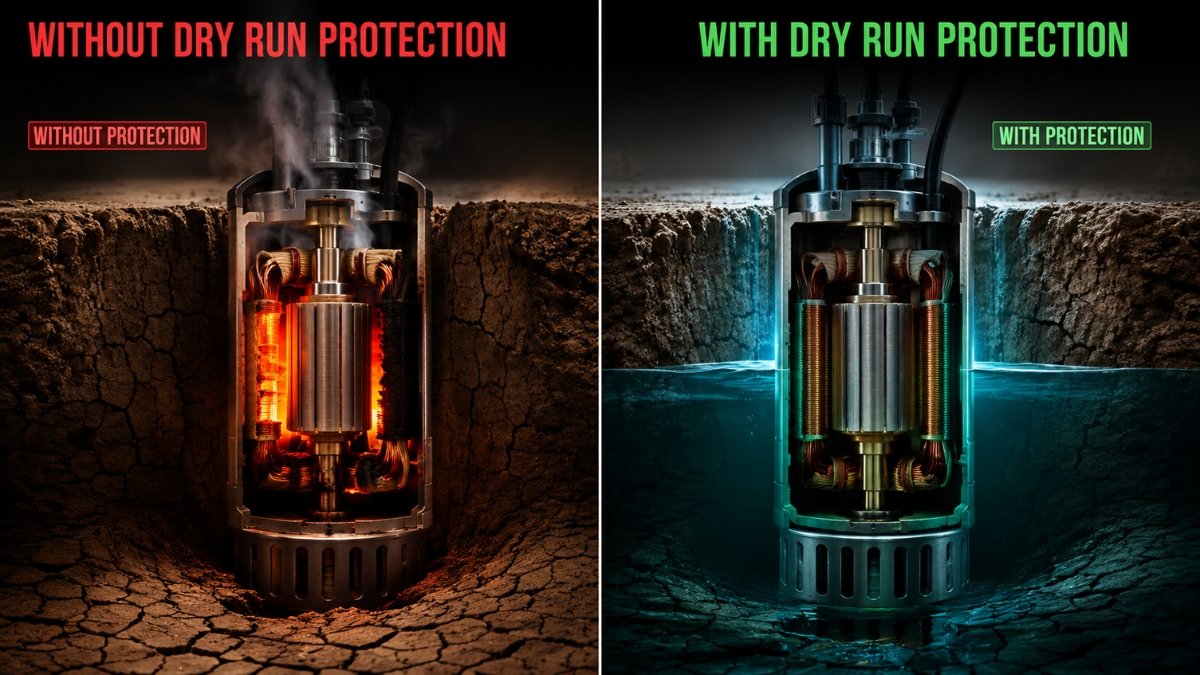
    What Actually Happens When a Pump Runs Dry?

    To understand why Dry Run Protection matters, you need to understand what a submersible or surface pump is actually doing when it runs.

    A pump doesn’t just move water. It relies on water for two critical functions that happen simultaneously:

    Cooling: The motor generates heat during operation. In a submersible borewell pump, the water flowing past the motor body carries that heat away continuously. Without water movement, there’s nothing to absorb the heat. Winding temperatures can climb from a normal 60°C to dangerous levels in under a minute.

    Lubrication: The pump’s internal seals and bearings are designed to operate with water as the lubricating medium. When water disappears, metal meets metal. Friction damage to the impeller, seals, and shaft bearings begins within seconds of dry running.

    When both fail simultaneously,  which is exactly what happens during a dry run,  the damage is rapid and severe. Studies and field data from Indian agricultural pump setups consistently show that a submersible pump can sustain irreversible damage in as little as 2 to 5 minutes of running completely dry.

    The problem is compounded in Indian conditions. Borewell water tables fluctuate seasonally,  dropping significantly in March through June across Tamil Nadu, Karnataka, Andhra Pradesh, and most of peninsular India. A borewell that delivers water reliably in January may run low by May. And a Water Pump Controller that doesn’t account for this is protecting you in only one season.

    Why a Basic Starter Isn’t Enough

    Most borewell pump setups in India run on a basic DOL Motor Starter,  a contactor, an overload relay, and start/stop buttons. The overload relay does protect against sustained overcurrent, but it’s not the same as Dry Run Protection.

    Here’s the gap: when a pump runs dry, the current drawn by the motor actually drops, not rises. The impeller is spinning freely with no load, so there’s less resistance and less current. A standard thermal overload relay is looking for excess current,  and it never sees it. The motor runs on and on, overheating, until a winding fails.

    This is the fundamental limitation of a basic starter for borewell applications. It protects against overload,  a load problem. It doesn’t protect against a dry run,  a no-load problem. These are two different failure modes, and they require two different protection mechanisms.

    A proper Automatic Pump Control System with built-in Dry Run Protection specifically monitors for the condition where the pump is running with insufficient water,  and responds appropriately, not by waiting for overcurrent, but by detecting the absence of water or the absence of expected flow load.

    How Dry Run Protection Works

    Modern Dry Run Protection systems use one or more of the following detection methods:

    Current sensing: The controller monitors the motor’s current draw in real time. A pump running dry draws measurably less current than one pumping water under load. The controller detects this drop and trips the motor automatically.

    Probe-based water level sensing: Electrode probes placed in the sump or source tank detect when the water level has dropped below a safe threshold. The controller cuts the motor before the source runs completely dry,  preventing a dry run before it even starts.

    Float switch integration: A float switch placed at the minimum safe water level in the sump triggers a direct cutoff signal when the water drops below that point.

    The Evolve AP 101–103 Domestic Water Management System and the ST 301 / ST 302 Three Phase Pump Protector (DOL) both incorporate intelligent Dry Run Protection systems,  the AP 10x series for single-phase surface pumps and the ST 30x series for 3-phase borewell and submersible pump applications.

    Evolve’s Dry Run Protection: What It Does in Practice

    In the AP 101–103 (Single-Phase Surface Pumps)

    The AP 10x Series is designed for single-phase surface pumps used in domestic water management, sump-to-overhead-tank, inline level control, and pressure booster setups. Its Intelligent Dry Run Protection monitors the water source continuously. The moment conditions fall below the safe threshold, the pump stops automatically before the motor can overheat.

    The system also includes Auto and Manual control modes, so when water returns to the source, the pump can restart automatically without you having to manually reset anything. LED status indicators show you the pump’s condition at a glance.

    Operating range: 140V to 320V,  handling the real-world voltage swings in the Indian domestic supply without complaint.

    Suitable for pumps up to 1.5 HP / 1 kW.

    In the ST 301 / ST 302 (Three-Phase Borewell and Submersible Pumps)

    For 3-phase borewell and submersible pumps- the more powerful, more expensive, and harder-to-service pump motors used in agricultural irrigation and commercial water supply- the ST 30x Series delivers Dry Run Protection alongside a full suite of motor protection features:

    • SPP (Single Phasing Prevention) trips the motor if any of the three phases drops out, one of the most destructive faults in 3-phase pump systems
    • Dry Run Protection monitors water availability and cuts the motor before damage occurs
    • Overload and fault protection protect against excess current from mechanical blockages or jams
    • High and Low Voltage Protection handles supply swings across its 270V to 520V operating range
    • Timer and Cyclic Operation,  for scheduled irrigation runs without manual switching
    • Manual Bypass Option allows direct motor operation even if the controller module needs servicing, so your pump is never completely stranded
    • Float Switch Compatibility (ST 302) integrates with tank-level float switches for full level-based automated control

    Suitable for pumps up to 20 HP / 15 kW, with a current rating of 18 to 32 Amps,  covering the full range of borewell pump motor sizes used in Indian agricultural and commercial setups.

    The Seasonal Reality: Why Borewell Owners Need This More Than Anyone

    Dry Run Protection matters year-round. But for borewell owners, it matters most in the months when groundwater levels are at their lowest,  typically February through June across most of India.

    During this period, a borewell that has reliably delivered water for years may start running low. The pump’s intake, positioned at a fixed depth, can find itself pulling from a depleted zone. Without protection, the pump runs on regardless,  and the motor pays the price.

    The irony is that the months when borewell water is most stressed- summer- are also the months when you can least afford a pump failure. Water demand is highest. Repair technicians are busiest. Lead times for motor rewinding or replacement are the longest.

    A Water Pump Controller with Dry Run Protection installed before the summer season begins is the difference between a system that manages itself through the stress period and one that fails at the worst possible time.

    What Does Motor Repair or Replacement Actually Cost?

    Let’s be direct about the numbers, because this is where the value of Dry Run Protection becomes undeniable.

    Damage Type Typical Cost
    Motor winding rewind (single-phase, 1–2 HP) ₹2,500 – ₹6,000
    Motor replacement (single-phase, 1.5 HP) ₹5,000 – ₹10,000
    Submersible pump pulled from the borewell (labour) ₹2,000 – ₹5,000
    Motor rewind/replacement (3-phase, 3–5 HP) ₹8,000 – ₹20,000
    Complete submersible pump replacement (3-phase, 5 HP) ₹15,000 – ₹40,000

    These are repair costs. They don’t account for the downtime,  the days without water supply, the irrigation cycles missed, the crop stress during a dry run failure in peak summer.

    The Evolve AP 101–103 and ST 301 / ST 302 cost a fraction of any entry in that table. And unlike a motor, they need no servicing, carry a one-year warranty, and continue protecting your pump every single operating cycle.

    5 Signs Your Pump Setup Doesn’t Have Adequate Dry Run Protection

    1. You’ve had a motor burnout with no clear electrical cause; dry run is the most likely culprit
    2. Your starter is a basic contactor-overload relay setup; no dry run detection is built in
    3. Your borewell is in an area where water tables drop in summer, a high-risk period every year
    4. Your pump runs unattended, and no one is around to notice the motor humming without water
    5. You’ve replaced the motor more than once in the past 5 years. Repeated dry run damage is the most common reason for premature motor replacement

    If any of these describe your situation, upgrading to a Water Pump Controller with built-in Dry Run Protection should be the next thing on your list,  before the next summer arrives.

    Choosing the Right Evolve Product for Your Setup

    Your Setup Recommended Product
    Single-phase surface pump, domestic use AP 101 / AP 102 / AP 103
    Single-phase pump + need for timed operation AP 103 (with RTC function)
    3-phase submersible or borewell pump ST 301
    3-phase pump + float switch/level control ST 302

    Both product lines share the same core commitment: protecting your motor from the faults that actually destroy pumps in Indian conditions, including Dry Run Protection, voltage range tolerance, and overload detection.

    Final Thought

    A borewell pump is not a cheap asset. The pump itself, the installation depth, the pipeline, and the control panel add up to a significant investment for any household or farm. And like any significant investment, it deserves protection proportional to what it costs to lose.

    Dry Run Protection is that protection. Not a luxury feature, not an optional add-on,  a fundamental safeguard against the most common mode of pump motor failure in India. It costs far less than one motor repair. It works every cycle, every season, whether you’re watching or not.

    Install it before the damage happens. Because by the time you hear the silence where the pump should be humming, it’s already too late.


  • How a DOL Motor Starter Protects Your Pump Motor During Voltage Fluctuations

    How a DOL Motor Starter Protects Your Pump Motor During Voltage Fluctuations

    There’s a sound every pump owner dreads, the hum that slowly turns into a buzz, then a click, then silence.

    Your 3-phase pump motor just tripped. Or worse, it burned out silently. No warning, no obvious cause. Just a motor that won’t start and a repair bill that’s about to ruin your week.

    Nine times out of ten, the culprit isn’t the motor itself. It’s what was happening in the electrical supply feeding it. Voltage fluctuations, a missing phase, overload current, a dry run that went undetected, any one of these can kill a pump motor. And without a proper DOL Motor Starter with intelligent protection built in, your motor has no defence against any of them.

    This is exactly what the Evolve ST 301 / ST 302 Three Phase Pump Protector is designed to prevent. But before we get into the product, let’s understand the problem it’s solving.

    Why 3-Phase Pump Motors Are So Vulnerable

    A 3-phase induction motor, the kind used in borewell submersible pumps, surface pumps, and agricultural irrigation systems, is built to run on a balanced three-phase power supply. All three phases (R, Y, B) need to be present, roughly equal in voltage, and within a safe operating range.

    In the real world, that’s rarely what actually happens.

    Voltage fluctuations are a fact of life on the Indian power grid. In agricultural areas, especially, the supply that comes in during morning and evening peak hours can swing from 270V to well above 450V within the same day. A motor designed for 415V doesn’t handle that range well; sustained overvoltage overheats the windings, and sustained undervoltage causes the motor to draw excess current trying to maintain speed, which also overheats the windings.

    Single phasing, when one of the three phases drops out, is particularly dangerous. A 3-phase motor will try to keep running on two phases, drawing nearly twice its rated current on the remaining phases. Without protection, the windings burn in minutes. This is one of the most common causes of motor failure in agricultural pump setups across India.

    Overload happens when the pump is tasked with more than its rated capacity, blocked impellers, excessive head pressure, cavitation, and the current drawn by the motor climbs past its safe limit. Again, without protection, the windings absorb all of that excess heat until something gives.

    Dry run is the water-specific version of the problem. When the borewell or sump runs dry, the pump has no water to move, but the motor keeps spinning, generating heat with no load to distribute it. Surface and submersible pumps can be destroyed in as little as 2–3 minutes of dry running.

    A basic DOL Motor Starter, a contactor, an overload relay, and start/stop buttons provide some protection. But a traditional starter can’t handle single phasing, voltage range monitoring, dry run detection, or automatic restart with timer logic. It just starts and stops the motor on command.

    A smart DOL Motor Starter like the Evolve ST 30x Series does all of it.

    What Is a DOL Motor Starter, Really?

    Direct-On-Line (DOL) starting means the motor is connected directly to full supply voltage at startup, as opposed to star-delta starters that reduce starting voltage for very large motors. DOL starting is the standard for pump motors up to about 20 HP, and it’s the most widely used starter type in Indian agricultural and domestic water pumping applications.

    A DOL Motor Starter does three things:

    1. Starts the motor, connects supply voltage to all three phases simultaneously on command
    2. Runs the motor, holds the contactor closed during operation
    3. Stops the motor, disconnects the supply on command or on fault detection

    What separates a basic DOL starter from a smart Water Pump Controller with DOL control is the intelligence built around steps 2 and 3, the ability to monitor what’s happening during operation and make protection decisions automatically.

    Introducing the Evolve ST 301 / ST 302, Three-Phase Pump Protector (DOL)

    The ST 30x Series from Evolve is a best-selling 3-phase DOL Motor Starter built specifically for surface and submersible pump systems used in agricultural irrigation, industrial water pumping, borewell setups, and commercial water supply.

    It goes well beyond a standard contactor-overload relay combination. Here’s what makes it stand out.

    Wide Voltage Operating Range: 270V to 520V

    Most standard contactors are rated for a specific voltage and start struggling, or failing, outside a narrow band. The ST 301 / ST 302 is rated for a wide voltage range of 270V to 520V, which covers the real-world conditions of Indian agricultural and semi-urban power supply without complaint. Whether supply swings low in the evening or spikes after midnight, the ST 30x is designed for it.

    SPP, Single Phasing Prevention

    This is arguably the most important protection feature for any 3-phase pump setup. The ST 30x Series includes built-in SPP (Single Phasing Prevention), it continuously monitors all three phases and immediately trips the motor if any phase drops out or falls out of balance.

    No single phasing means no two-phase running. No two-phase running means no catastrophic winding burnout from the commonest fault in Indian 3-phase supply systems.

    Dry Run Protection System

    The built-in Dry Run Protection system detects when the pump is running without water and cuts power before the motor can be damaged. For borewell and submersible installations where monitoring the water source physically isn’t practical, this feature is the difference between a long-lived motor and an expensive replacement.

    Overload and Fault Protection

    The ST 30x monitors current in real time and trips on overload when the current drawn by the motor exceeds its safe rating. This protects against blocked impellers, excessive system head, or mechanical jams that cause the motor to draw more current than it should.

    It also handles general fault conditions and provides clear fault indication through its LED indicators, so you know exactly what tripped the system when you come to check it.

    Built-In Voltage and Current Display

    The ST 301 / ST 302 includes a live voltage and current display, so the operating parameters of your pump are always visible. For agricultural setups where a pump might run unattended for hours, being able to glance at the panel and see actual operating voltage and current is a practical advantage that basic starters simply don’t offer.

    LED Indicators for Real-Time Status

    The LED status indicators give you an at-a-glance view of power status, motor run state, fault conditions, and phase health, without needing to dig into wiring or call an electrician to diagnose what’s happening.

    Timer and Cyclic Operation Modes

    The ST 30x supports timer and cyclic operation modes, allowing you to programme the pump to run on a schedule, or in repeating on/off cycles. For agricultural irrigation applications, this is essential for managing water efficiently across large fields without requiring manual switching at each cycle.

    Manual Bypass Option

    One of the practical engineering decisions in the ST 30x is the manual bypass option, which allows the pump to be operated directly even if the control module develops a fault. In agricultural or industrial settings where water supply cannot be interrupted, this redundancy is critical. The pump doesn’t stop just because the controller needs attention.

    Float Switch Compatibility (ST 302)

    The ST 302 variant adds float switch support, allowing it to integrate directly with tank-level sensors for automated water management, stopping the pump when the overhead tank is full and restarting when it drops. This makes the ST 302 a full Automatic Pump Control System for applications that need both motor protection and level-based control in a single unit.

    Plug & Play Modular Architecture

    The ST 30x Series is built on a plug-and-play modular architecture, making installation straightforward and maintenance easier. Individual modules can be replaced without rewiring the entire panel, which matters in field environments where an electrician may not always be immediately available.

    IP52 Enclosure, Built for Field Conditions

    The durable ABS enclosure with IP52 protection resists dust ingress and limited water spray, appropriate for pump rooms, agricultural field installations, and outdoor sheltered setups where conditions aren’t always clean or dry.

    The Real Cost of Running Without Protection

    Let’s put this in concrete terms.

    A 5 HP submersible borewell pump motor costs anywhere from ₹8,000 to ₹20,000 depending on the brand and specifications. Pulling a submersible pump from a borewell for motor replacement adds ₹2,000–₹5,000 in labour costs, plus the downtime of an irrigation system that may be serving an active crop cycle.

    A single phasing event that goes undetected for 10–15 minutes can burn the motor completely. A dry run episode during summer, when borewell water levels drop, can do the same in under 5 minutes.

    The Evolve ST 301 / ST 302 costs a fraction of any of these scenarios, and it’s a one-time investment that extends across the entire operating life of the pump.

    More than the direct cost, there’s the cascading damage of unplanned downtime. A pump failure during sowing season or peak irrigation demand affects the entire crop cycle, not just the motor.

    Who Is the ST 301 / ST 302 For?

    The ST 30x Series is the right fit for anyone operating a 3-phase surface or submersible pump where reliable, protected, automated operation is needed:

    • Farmers running borewell or open well pumps for irrigation, especially where power quality is poor and manual monitoring isn’t always possible
    • Agricultural setups needing cyclic timer operation for scheduled irrigation runs
    • Industrial water pumping applications where pump failure means operational downtime
    • Commercial water supply systems, apartments, complexes, campuses, where 3-phase pumps feed storage or overhead tanks
    • Water transfer and storage setups with large pump sets that need overload and voltage protection

    If your current setup is a basic contactor-overload relay combination with no voltage monitoring, no SPP, and no dry run detection, the ST 30x is the direct upgrade that addresses every protection gap.

    ST 301 vs ST 302, Which One Do You Need?

    Both models share the same core protection platform. The difference is one feature:

    ST-301, Core DOL protection for applications where level-based control is handled separately (or not needed). Full voltage, current, SPP, overload, dry run, and timer protection.

    ST-302, Everything in the ST-301 plus float switch compatibility for applications where the pump needs to respond to tank water levels automatically. This makes it the better choice for sump-to-overhead-tank setups and storage management applications.

    If you’re only protecting the motor and don’t need level-based auto control, the ST-301 is sufficient. If you want the pump to also respond to float switch signals from a tank, go with the ST-302.

    Final Thought

    A pump motor is one of the hardest-working pieces of equipment in any home, farm, or facility. It runs in conditions that most electrical equipment never faces: unstable three-phase supply, variable water availability, outdoor temperatures, and hours of continuous operation.

    A basic DOL starter keeps it running. A smart DOL Motor Starter like the Evolve ST 301 / ST 302 keeps it running safely and keeps running for years longer than an unprotected motor ever would.

    The protection is real. The faults it catches are real. And the cost of not having it, one burnt motor, one failed crop cycle, one week of dry taps, is very real too.
  • Water Level Controller,  How It Stops Tank Overflow and Dry Run Automatically

    Water Level Controller, How It Stops Tank Overflow and Dry Run Automatically

    Let me paint a picture you’ve probably lived through.

    It’s 6 in the morning. You turn on the tap to wash your face, and nothing comes out. You walk to the terrace, check the overhead tank,  bone dry. The pump ran all night, the sump emptied hours ago, and the motor burned out trying to pull water that wasn’t there. Or the opposite: you forgot the pump was on, the overhead tank overflowed, water ran down the walls all night, and you woke up to a soaked ceiling and a neighbour at the door.

    Both situations are frustratingly common in Indian homes. And both are completely avoidable.

    A Water Level Controller is what stands between you and these problems. Not a luxury. Not a complicated installation. Just a small, intelligent device that watches your tanks around the clock and handles everything automatically,  so you don’t have to.

    Why Manual Pump Operation Doesn’t Work Anymore

    Most Indian homes still rely on someone to physically switch the pump on in the morning and off when the tank is full. This worked well enough when life was slower. It doesn’t anymore.

    People forget. They step out. They fall asleep. One distraction and the tank is overflowing,  or the pump is running dry. And it’s not just water that gets wasted. A motor running without water for even a few minutes generates intense heat. Over time, repeated dry run cycles shorten the motor’s life dramatically. Repair or replacement costs can run into thousands of rupees, all because of a moment of inattention.

    A proper Automatic Pump Control System takes this responsibility entirely off your hands. The pump starts when it should, stops when it should, and protects itself when conditions aren’t safe,  automatically, every single time.

    What Is a Water Level Controller and How Does It Work?

    A Water Level Controller is a device that monitors the water levels in your tanks and controls your pump accordingly,  without any manual input from you.

    Here’s the basic logic it follows:

    • Overhead tank is low + Sump has water → Pump switches ON automatically
    • Overhead tank is full → Pump switches OFF automatically
    • Sump is empty (dry run risk) → Pump stays OFF until water returns

    This seems simple, but the intelligence behind it,  monitoring two tanks simultaneously, making safe decisions in real time, protecting the motor, and adapting to voltage fluctuations- is exactly what makes a quality Water Pump Controller worth every rupee.

    Introducing the Evolve AP 101–103: A Domestic Water Management System Built for Indian Homes

    The Evolve AP 10x Series,  comprising the AP-101, AP-102, and AP-103,  is a compact, plug-and-play Domestic Water Management System designed specifically for single-phase surface pumps used in Indian households.

    It isn’t just a basic on/off controller. It’s an AI-optimised Automatic Pump Control System that manages water filling intelligently, monitors voltage conditions, protects the pump from dry run damage, and does it all with minimal footprint and zero fuss.

    Plug & Play,  No Electrician Drama

    One of the most practical things about the AP 10x series is how straightforward it is to set up. The compact design and plug-and-play architecture mean you’re not looking at a major rewiring project. It’s built for real homes, not engineering labs.

    Works on Unstable Indian Power Supply

    The AP 101–103 operates across a wide voltage range of 140V to 320V. This is significant. Indian power supply,  especially in smaller cities, peri-urban areas, and older residential layouts,  fluctuates constantly. A controller that only works between 200–240V is going to trip and cause problems constantly. The AP 10x series handles the real-world range you actually deal with.

    Built-In Dry Run Protection,  No Motor Will Burn on Its Watch

    This is arguably the most critical feature for Indian borewell and sump-based water systems. When the sump or source runs dry, the AP 101–103’s Intelligent Dry Run Protection detects the condition and immediately cuts power to the pump.

    This is the feature that saves your motor. A submersible or surface pump running without water builds heat rapidly. Without a Dry Run Protection mechanism, you’re one empty sump away from a burnt winding and a repair bill. The AP 10x series simply doesn’t let it get that far.

    Auto and Manual Modes

    Not every situation calls for full automation. The AP 10x series gives you both Auto and Manual control modes,  so you retain the option to operate the pump manually whenever needed, while the device takes over on automation for daily operation.

    LED Status Indicators,  Always Know What’s Happening

    The built-in LED status indicators give you a live read of the system at a glance. Motor on, motor off, water levels, fault conditions,  everything is visible without having to physically check the tanks or guess what’s going on.

    Built-In Voltage and Current Monitoring

    Beyond water level management, the AP 101–103 also monitors voltage and current in real time. This keeps the motor protected from power quality issues that are common in Indian residential areas,  and that most basic controllers completely ignore.

    RTC Function,  Available in Selected Models

    The AP-103 model includes an RTC (Real-Time Control) function, which gives you time-based control over the pump operation. This is useful for households that want to run the pump only at specific times of day,  reducing electricity costs and ensuring quieter operation during night hours.

    Technical Specifications at a Glance

    Specification Details
    Voltage Range 140 – 320V
    Frequency 50 Hz
    Power Up to 1 kW / 1.5 HP
    Current 10 Amps
    Dimensions 60 × 70 × 75 mm
    Weight 230 g
    Enclosure Durable ABS
    Warranty 1 Year

    The Two Problems It Solves,  Every Single Day

    Problem 1: Tank Overflow

    Overhead tank overflow is one of the most common and avoidable water waste problems in Indian homes. The tank fills up, the pump keeps running, water pours over the edge,  down the wall, into the building structure, or just straight onto the street.

    With the AP 101–103, the moment the tank reaches the set full level, the pump stops. Automatically. No overflow. No water waste. No damage to walls or ceilings.

    Problem 2: Dry Run Damage

    The other end of the problem,  a pump running without water,  is more expensive in terms of damage. When your sump empties and the motor keeps running, the windings heat up rapidly. What would have been a fine-running motor can be ruined in minutes.

    The AP 10x series monitors the source water level and cuts the motor before dry run conditions can cause damage. The pump simply waits until water is available again, then resumes automatically. Your motor stays healthy. Your repair costs stay zero.

    Who Is This For?

    The AP 101–103 is the right fit if:

    • You have a single-phase surface pump at home for sump-to-overhead-tank water management
    • You’re tired of manually switching the pump on and off every morning
    • You’ve had a motor burnout from dry run,  and don’t want it to happen again
    • You live in an area with voltage fluctuations and need a controller that handles the range
    • You want overhead tank level control that’s fully automatic with a manual override when needed
    • You’re setting up a residential water automation system without wanting to overcomplicate it

    It’s also well suited for pressure booster systems and inline water level management applications in apartments and small commercial buildings.

    Choosing Between AP-101, AP-102, and AP-103

    All three models share the same core platform, the same voltage range, the same current rating, the same Dry Run Protection, and the same build quality. The difference lies in configuration and added features:

    • AP-101,  Core model for standard sump-to-overhead-tank automation
    • AP-102,  Flexible configuration for different water management setups
    • AP-103, includes RTC (Real-Time Control) for time-based pump scheduling

    If you want full automation with time-based control, the AP-103 is the right pick. For straightforward daily water management, the AP-101 handles everything you need.

    Why Automate Your Water Management Now?

    The cost of a motor burnout,  pulling a submersible pump from a borewell, rewinding or replacing it, and labour charges easily runs between ₹4,000 and ₹15,000 depending on the motor and the depth of the borewell.

    The cost of months of tank overflow,  seepage damage, repainting walls, and structural repair can run even higher, silently, over time.

    The Evolve AP 10x series costs a fraction of either of these. And it pays for itself the very first time it catches a dry run or prevents a 3 AM overflow.

    More than the money, there’s the daily mental load of monitoring water levels, remembering to switch the pump, worrying when you’re not home. A proper Automatic Pump Control System takes all of that off your plate permanently.

    Final Thought

    Water management in Indian homes shouldn’t depend on someone remembering to check a tank or switch a motor. It’s a repetitive, error-prone, daily task that technology has been able to handle for years.

    The Evolve AP 101–103 Domestic Water Management System is what that automation looks like in practice: compact, reliable, built for Indian voltage conditions, and smart enough to protect your pump even when no one’s watching.

    Install it once. Let it do the rest.

  • Monsoon-Proofing Your Water Pump: A Seasonal Checklist for Indian Homeowners

    Monsoon-Proofing Your Water Pump: A Seasonal Checklist for Indian Homeowners

    The monsoon is a blessing, but for your water pump, it can be a nightmare.

    Waterlogging around the motor. Voltage fluctuations from storm-related tripping. Mud and debris are entering the sump, and dry runs occur when the borewell supply drops unpredictably. Every year, thousands of Indian homeowners face pump failures right when they need water the most, during or just after heavy rain.

    The good news? Most of these failures are completely preventable. This checklist walks you through everything you need to do before, during, and after the monsoon to keep your Water Pump Controller system running smoothly all season long.

    Why Monsoon Is the Hardest Season for Water Pumps

    You might expect the monsoon to be easy on pumps; after all, there’s plenty of water. But the reality is more complicated:

    • Voltage instability spikes during storms when multiple grid circuits trip and restore rapidly. Without a high-low voltage protector for the home, your pump motor is exposed to every fluctuation.
    • Flooding around motor bases causes insulation damage, short circuits, and rust, especially for surface-mounted monoblock pumps.
    • Borewell supply changes heavy rain can cause soil shifts that temporarily reduce or alter borewell yield, triggering dry run conditions.
    • Sump contamination from surface runoff can clog inlet filters and strain pump performance.
    • Humidity and condensation inside control panels corrode contacts and trip breakers unexpectedly.

    The solution isn’t just waterproofing; it’s building a fully Automatic Pump Control System that handles all of these variables without requiring you to intervene manually every time something changes.

    The Pre-Monsoon Checklist (Do This in May–June)

    1. Inspect and Clean the Pump and Motor

    Before the rains arrive, physically check your pump:

    • Remove and clean the inlet strainer or foot valve to clear accumulated debris from summer
    • Check motor winding insulation with a megger if possible, or have a technician do it
    • Look for rust, corrosion, or cracked casing on surface pumps
    • Ensure the motor base is elevated at least 6–12 inches above the likely waterlogging level in your area

    For Submersible Borewell Pumps, check the cable condition from the surface. Nicks or exposed wiring underwater during the monsoon can cause short circuits and shock hazards.

    2. Install or Upgrade Your Dry Run Protection

    This is the single most important upgrade you can make before the monsoon.

    When borewell water levels shift due to soil movement or increased extraction by neighbours, your pump can run without any water and burn out within minutes. A Dry Run Protection device detects this condition instantly and cuts power before damage occurs.

    Modern Water Pump Controllers from Evolve include built-in dry run detection as part of the Automatic Pump Control System, eliminating the need for a separate add-on device. If your current setup lacks this feature, monsoon is the right time to upgrade.

    3. Set Up a Water Level Controller

    Overflow is a monsoon-specific problem. With tanks filling faster due to rain harvesting or increased municipal supply, pumps left on manual control often overflow sumps and overhead tanks, wasting water and causing structural seepage.

    A Water Level Controller automates the entire fill cycle, starting the pump when the tank is low and stopping it when it is full. No manual switching. No overflow. No dry run from an empty source.

    Look for a controller that handles both sump and overhead tank levels simultaneously, with separate sensor inputs for each.

    4. Check Your Voltage Protection Setup

    Monsoon storms cause frequent and sudden voltage swings. Your pump motor, especially a DOL Motor Starter setup, is vulnerable to both overvoltage spikes and undervoltage sags.

    Make sure you have at a minimum:

    • A High Low Voltage Protector in line with the pump power supply
    • A Voltage Stabilizer if your area has chronic undervoltage issues
    • A Surge Protector Plug or Power Protection Plug at the control panel input

    For three-phase motor setups, upgrade to a 3 Phase Voltage Protector that monitors all three phases independently. Single-phase failure in a three-phase pump is a common monsoon season motor killer.

    5. Upgrade to an Automatic Timer Switch

    If you rely on fixed schedules to run your pump, consider replacing manual timers with a smart Automatic Timer Switch that adjusts based on actual tank levels rather than a fixed clock. During the monsoon, water availability changes daily; a fixed timer will either waste power running when the tank is already full, or leave you without water when it runs outside your expected window.

    6. Weatherproof Your Control Panel

    Humidity during the monsoon corrodes electrical contacts inside control panels within weeks. Before the rains:

    • Seal all open cable entry points with waterproof glands or silicone
    • Apply a thin coat of contact cleaner to relay terminals and contractor points
    • Ensure the panel door gasket is intact
    • Mount the panel at least 5 feet above ground level if located outdoors or in a flood-prone area

    For DOL Motor Starter panels, check that the overload relay setting matches your pump’s rated current; it tends to drift with thermal cycling over summer.

    During Monsoon: What to Monitor

    Watch for These Warning Signs

    Even with a well-prepared system, monsoon conditions change fast. Keep an eye on:

    Repeated tripping: If your pump trips and restarts multiple times in a short period, it’s usually a voltage fluctuation or dry run. A GSM Pump Controller can alert you via SMS when this happens, even when you’re away from home.

    Unusual noise from the pump: Cavitation (gurgling or rattling) during operation often means the pump is partially drawing air, an early sign of dry run or a blocked foot valve.

    Water colour change: Yellow or muddy water from taps after rain is a sign that surface runoff has contaminated the sump. Stop the pump and clean the sump before continuing.

    Pressure drops: If water pressure at your taps weakens despite the pump running, the Automatic Irrigation System or other connected lines may have a blockage from debris.


    For Agricultural and Irrigation Setups

    If you’re running a Drip Irrigation System or Automatic Irrigation System on agricultural land, the monsoon brings its own set of challenges:

    • Excess soil moisture can falsely trigger Moisture Sensor readings; adjust sensitivity thresholds for the season
    • Check drip emitters and filters for clogging from silty water after heavy rain
    • If your Agricultural Automation setup includes an Automatic Solenoid Valve, test each valve manually at the start of the monsoon to confirm correct operation
    • For remote farms, a GSM Pump Controller allows you to remotely start, stop, and monitor your pump, critical when roads may be inaccessible during heavy rain

    Post-Monsoon Checklist (September–October)

    Once the rains ease, do a full system review:

    1. Check Motor Insulation Again

    Moisture ingress during the monsoon can reduce insulation resistance significantly. A post-monsoon motor insulation test catches problems before they cause failure in the dry season.

    2. Flush the Foot Valve and Strainer

    Monsoon silt accumulates in the foot valve. A blocked foot valve reduces pump suction, causing cavitation and motor strain.

    3. Inspect All Sensor Probes

    If you’re using an SS-probe-type Water Level Controller, clean the probe rods, mineral deposits, and biofilm buildup faster during the monsoon due to higher water activity.

    4. Review Your Motor Starter Settings

    For DOL Motor Starter panels, verify that the overload settings and contactors haven’t drifted or pitted due to the season’s switching cycles.

    5. Test Your Automatic Solenoid Valve

    If any solenoid valve shows sluggish response or sticking, clean or replace the diaphragm before it fails in the drier months ahead.

    The Smart Setup: What a Fully Monsoon-Ready Pump System Looks Like

    For a typical Indian home with a borewell, sump, and overhead tank, here’s what a complete, monsoon-proof Automatic Pump Control System should include:

    Component Purpose
    Water Level Controller Automates start/stop based on tank levels
    Dry Run Protection Cuts power when the borewell runs dry
    High-Low Voltage Protector for Home Guards the motor from voltage swings
    DOL Motor Starter Controls motor starting current
    Automatic Timer Switch Backup schedule control
    Surge Protector Plug / Power Protection Plug Protects the control panel from spikes
    GSM Pump Controller (optional) Remote monitoring and SMS alerts

    With all of these in place, your pump system runs autonomously through the monsoon, protecting itself from dry run, overflow, voltage damage, and flooding, without requiring you to manually intervene every time conditions change.

    Final Word: Prevention Costs Less Than Repair

    A burnt-out submersible pump motor costs ₹4,000–₹15,000 to replace, plus labour for pulling the pump from the borewell. A DOL Motor Starter replacement, rewiring, and control panel repair after a monsoon surge can run even higher.

    The smart investments, a Water Level Controller, Dry Run Protection, and a High-Low Voltage Protector, cost a fraction of that, and they pay for themselves the first time they prevent a failure.

    This monsoon, don’t wait for your pump to break down to start thinking about protection. Set it up now, before the first rains arrive.

  • How a Single Power Surge Can Destroy Your TV or Fridge, And How to Stop It

    How a Single Power Surge Can Destroy Your TV or Fridge, And How to Stop It

    You’ve just bought a brand-new 55-inch smart TV. You set it up, settle into the couch, and halfway through your favourite show, click. The screen goes blank. Not because of a power cut. Because of a voltage spike that lasted less than a second.

    It happens more often than most people realise. And in most cases, it’s completely preventable. 

    The Problem No One Talks About: Voltage Instability in Indian Homes

    India’s power grid, despite years of improvement, still delivers inconsistent voltage to homes and offices, especially in smaller cities, industrial areas, and places with shared transformers. What comes out of your wall socket is supposed to be a steady 230V. What actually arrives can swing wildly between 150V and 280V throughout the day.

    These swings cause two types of damage:

    Overvoltage, when voltage spikes above the safe limit, pushes excess current into your appliance’s internal circuits. Capacitors blow. Circuit boards fry. Compressors burn out.

    Undervoltage, when voltage drops too low, appliances like refrigerators and air conditioners strain to draw enough power, overheating their motors in the process.

    Neither type of damage is covered under most standard warranties. Because the manufacturer didn’t cause it. Your wiring did.

    What Happens to Your Appliances During a Surge

    Think of it this way: every appliance is designed to run within a specific voltage range. When power quality falls outside that range, even briefly, here’s what’s at risk:

    • Televisions and monitors, the most sensitive. A single surge can kill the display driver or motherboard instantly.
    • Refrigerators, compressor burnout from repeated undervoltage is one of the most common (and expensive) appliance repairs in India.
    • Computers and routers, power surges can corrupt data, damage storage drives, or destroy the power supply unit entirely.
    • Office equipment, printers, scanners, and UPS units are all vulnerable to spikes and poor power quality.

    The scary part? In most cases, the damage is silent and gradual. Your appliance doesn’t die immediately; it just gets a little weaker each time. Until one day, it doesn’t turn on at all.

    The Simple Fix: Plug-Level Protection

    Most people think appliance protection means buying a big voltage stabiliser, the large box that sits behind the fridge or AC. While those have their place, they’re bulky, expensive, and impractical for every device in your home.

    There’s a smarter, simpler approach: plug-level protection.

    The idea is straightforward. Instead of protecting your entire electrical circuit, you protect each appliance individually at the point of connection. Plug the protector into the socket. Plug your appliance into the protector. That’s it.

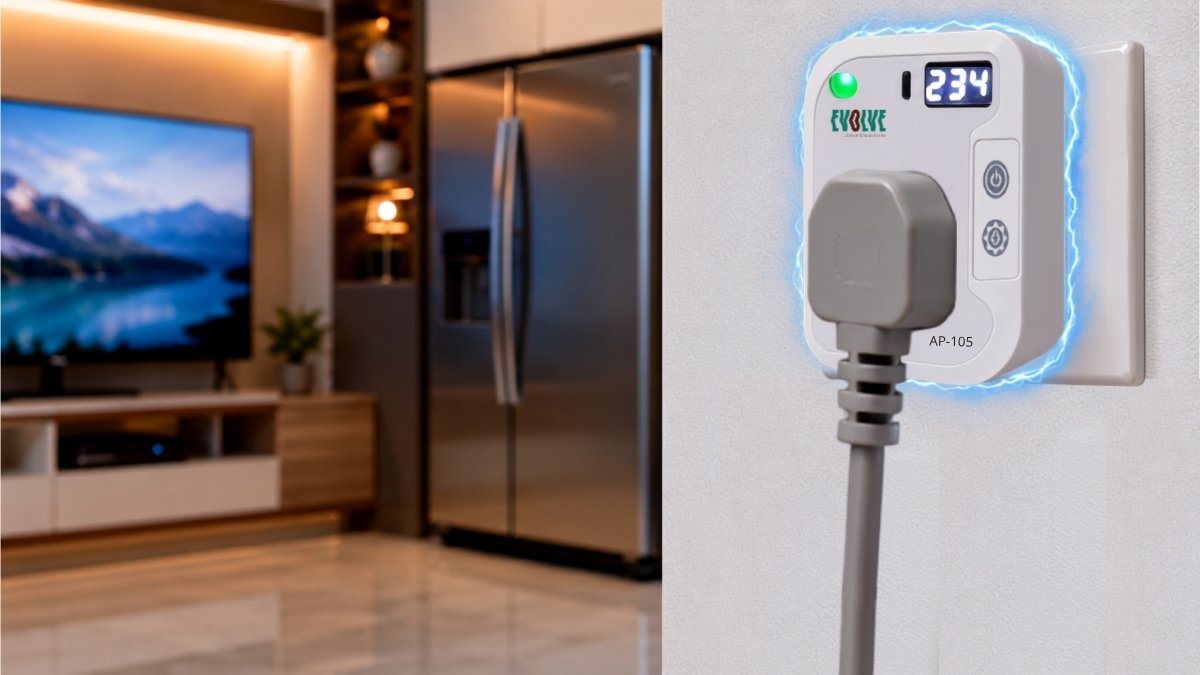
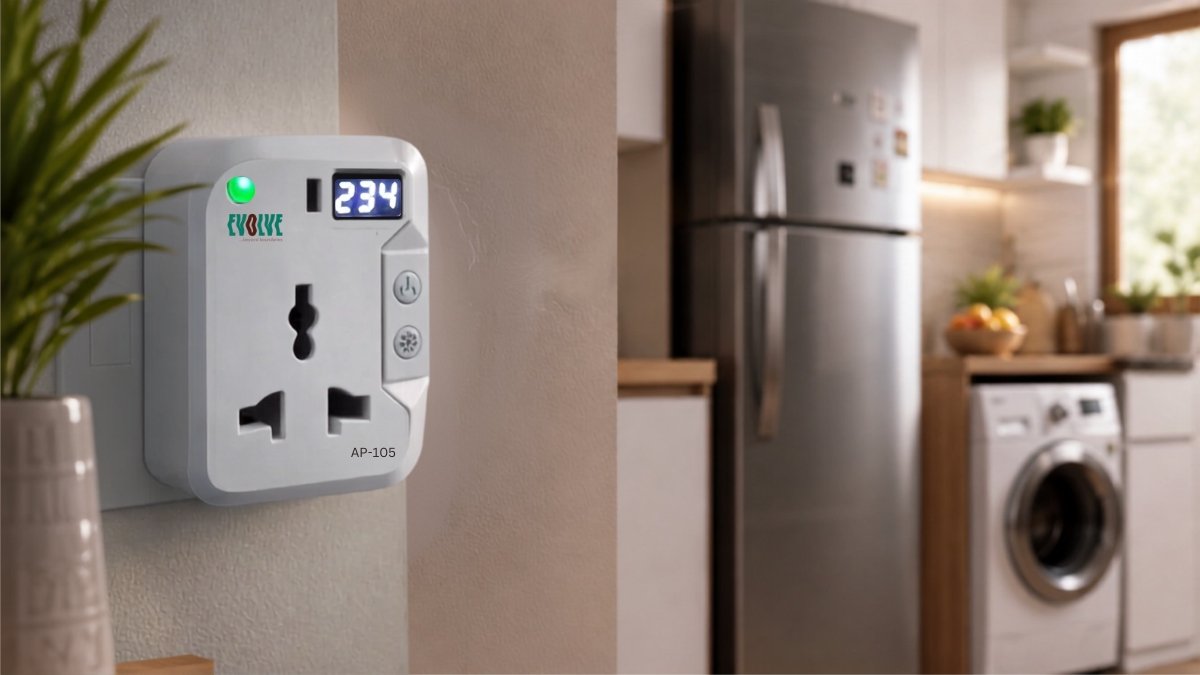
    Meet the Evolve AP 105, Appliance Protection Plug

    The Evolve AP 105 is built exactly for this purpose. It’s a compact, plug-and-play device that sits between your wall socket and your appliance, monitoring incoming voltage in real time and cutting power the moment conditions become unsafe.

    Here’s what makes it stand out:

    It Works Instantly, No Setup Required

    There’s nothing to configure. No app to download. No technician needed. Plug it in, and it starts working. The built-in LED display shows you live voltage and current readings, so you always know what your power supply is actually delivering.

    It Protects Against the Full Range of Power Problems

    The AP 105 handles both ends of the problem, overvoltage and undervoltage, as well as surges and spikes. Its protection range spans 110V to 600V, which means it catches dangerous conditions well before they reach your appliance.

    It Waits Before Restarting

    This is one of its most underrated features. When power is restored after a fluctuation, the AP 105 doesn’t immediately switch your appliance back on. It waits for the voltage to stabilise first, then restores power with a controlled delay. This restart delay protects appliances, especially refrigerators and compressors, from the damage caused by repeated switching.

    One customer from Chennai, Saravanan, described it well: during a voltage spike at his office, all the systems around him kept cycling on and off repeatedly. His system, connected through the AP 105, simply waited. It powered back on only after the voltage returned to a safe level.

    It’s Built to Last

    The AP 105 is housed in durable ABS plastic and rated to operate in temperatures between -5°C and +50°C, with humidity resistance up to 50% at 40°C. For anyone living in Tamil Nadu or coastal regions, that tolerance matters.

    Real Situations Where the AP 105 Steps In

    Scenario 1: Evening voltage drops in residential areas. As cooking and AC usage peak around 7–9 PM, local transformers get overloaded and voltage drops. The AP 105 detects the drop and disconnects your TV or fridge until conditions normalise.

    Scenario 2: Voltage spike after a power cut. When electricity returns after an outage, it often comes back with a brief surge. The AP 105 absorbs the surge and holds off reconnecting your appliance until the supply settles.

    Scenario 3: Office equipment during load-shedding hours. Computers and printers in areas with irregular power supply benefit from the AP 105’s overload detection, which cuts power before damage occurs, as Niharika from Bangalore experienced with her air cooler.

    Who Should Use This?

    The AP 105 is practical for almost anyone, but it makes the most sense if you:

    • Live in an area with frequent power cuts or voltage fluctuations
    • Have recently bought an expensive appliance, and you want to protect it
    • Use sensitive electronics like computers, routers, or home theatre systems
    • Run a small office or home business with equipment that can’t afford downtime
    • Travel and want portable protection for devices in unfamiliar locations

    At ₹799, it costs far less than a single service call for a damaged compressor or circuit board replacement.

    One Device. Multiple Appliances Covered.

    The AP 105 comes with a universal socket, meaning you can use it with a wide range of Indian plug types. It supports loads up to 1.6 kW and 6 Amps, suitable for TVs, refrigerators, computers, routers, and other common household and office electronics.

    For larger appliances like air conditioners or washing machines, Evolve’s broader Appliance Protection range offers solutions built for higher load requirements.

    The Bottom Line

    Voltage problems in India aren’t going away. But the damage they cause to your appliances is avoidable. The Evolve AP 105 is one of the most affordable, hassle-free ways to add a layer of protection to the electronics you use every day, without rewiring anything or spending thousands on stabilisers.

    Plug it in. Forget it’s there. Let it do its job.

    Get the Evolve AP 105 – Appliance Protection Plug →

    Also available on Amazon and Flipkart.

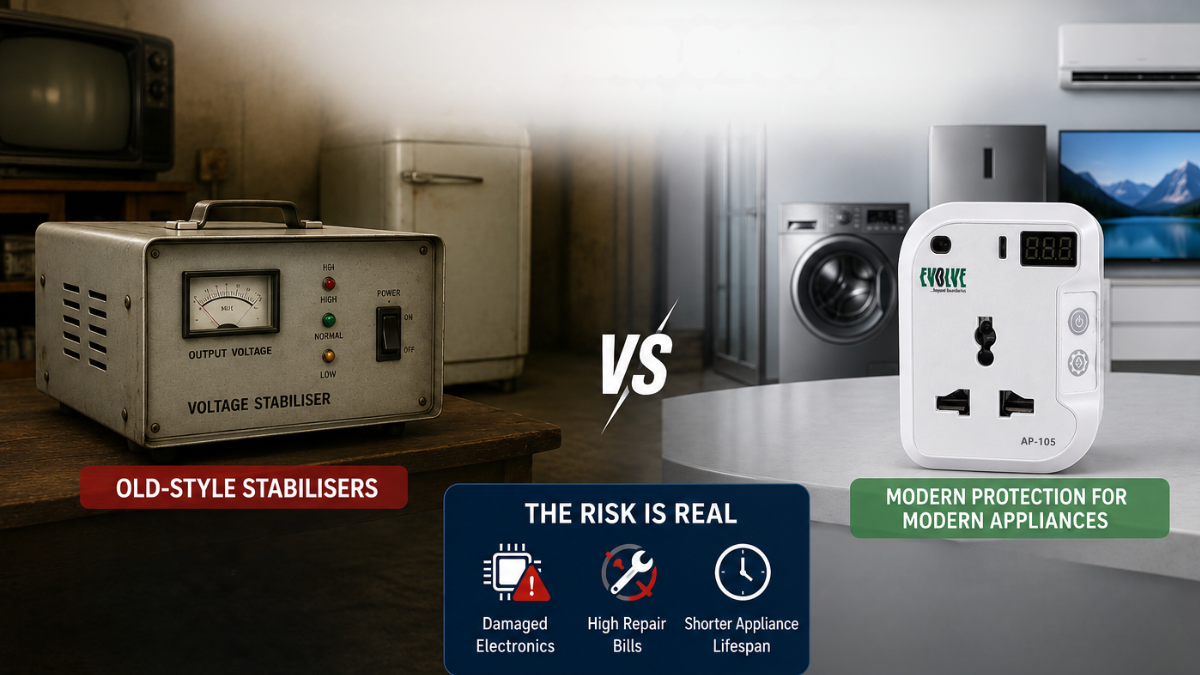
  • Why Old-Style Voltage Stabilisers Are No Longer Good Enough for Modern Appliances

    Why Old-Style Voltage Stabilisers Are No Longer Good Enough for Modern Appliances

    If you grew up in an Indian household anytime before the 2010s, chances are there was a big, humming metal box sitting quietly next to the fridge or the TV. That was the voltage stabiliser, the unsung guardian of our appliances, doing its job for decades without much fuss. For a long time, it was enough. It kept the fridge from tripping when the voltage sagged during a thunderstorm, and it stopped the old CRT television from frying its circuit board.

    But here’s the thing: the appliances in our homes today are nothing like the ones from twenty years ago. And the stabilisers protecting them, in most homes, haven’t changed much at all. That mismatch is starting to show, in shorter appliance lifespans, in mysterious electronic failures, and in repair bills that shouldn’t really be happening.

    Let’s talk about why.

    The Old Stabiliser Was Built for a Different Era

    Traditional voltage stabilisers work on a fairly simple principle. They use a relay-based or servo-motor mechanism to step voltage up or down within a certain range, correcting it before it reaches your appliance. This worked well for older electronics because those devices had relatively simple internal components, basic transformers, motors, and circuits that could tolerate small swings in voltage without much drama.

    Modern appliances are a completely different animal. Your refrigerator now has an inverter compressor. Your washing machine has a microprocessor controlling wash cycles. Your TV is essentially a small computer. Air conditioners, microwaves, mixers, and even ceiling fans increasingly run on sensitive electronic boards rather than purely mechanical parts. These components are precise, power-hungry in short bursts, and far less forgiving of electrical irregularities than anything from the stabiliser’s heyday.

    Where Old-Style Stabilisers Fall Short

    They React Too Slowly

    Most conventional stabilisers, especially the relay type, correct voltage in noticeable steps rather than smoothly. There’s a small but real lag between when the voltage fluctuates and when the stabiliser catches up. For a 1990s refrigerator, that lag was harmless. For a modern inverter AC or a smart washing machine, that same lag can be enough to stress sensitive components every single time it happens, and it happens more often than most people realise, especially in areas with unstable grid supply.

    They Don’t Handle Surges and Spikes

    A voltage stabiliser is designed to manage gradual fluctuations, voltage that’s too low or too high over a sustained period. It is not built to handle sudden spikes, like the kind caused by lightning strikes, transformer faults, or even the appliance next door switching on and off. These spikes last for a fraction of a second but can do permanent damage to circuit boards. Old-style stabilisers simply weren’t designed with this threat in mind, because it wasn’t as big a concern when they were first built.

    No Real Intelligence or Monitoring

    Here’s something people don’t think about until it’s too late: a traditional stabiliser has no way of telling you anything is wrong. It doesn’t know if it’s overheating, if a fault has developed inside it, or if the supply voltage has gone dangerously out of range. It just keeps doing what it does, until one day, it doesn’t, and you find out only when your appliance stops working too.

    One Size Rarely Fits the Modern Home

    Many households still use a single large stabiliser for the entire house or for a handful of appliances. Multiple devices with very different power needs end up depending on one piece of ageing equipment. Today’s appliances, especially ones with inverter technology, have load patterns that are far more variable than older devices. A single generic stabiliser struggles to serve all of them equally well.

    They Age Quietly, and Then Fail Loudly

    Mechanical parts wear out. Relays in older stabilisers degrade with use, contacts get worn down, and internal components lose efficiency over the years. The frustrating part is that this degradation is invisible; the stabiliser looks the same, sounds the same, and nobody really checks it until an appliance gets damaged and the stabiliser is found to be the silent cause.

    What Modern Appliances Actually Need

    Modern electronics need protection that’s fast, precise, and a little bit smarter than what we were used to. That means:

    Quicker response times that correct fluctuations almost instantly, rather than in noticeable jumps. Genuine surge protection that handles sudden spikes, not just slow voltage drift. The ability to monitor and protect individual appliances rather than relying on one box for everything. And ideally, some way to know when something is actually wrong, instead of finding out the hard way.

    This is really the gap that newer power protection technology is built to close, not replacing the basic idea of a stabiliser, but rethinking how voltage protection should work for the kind of electronics we actually use today.

    So, Should You Replace Your Old Stabiliser?

    Not necessarily overnight, and not out of panic. But it’s worth asking a few honest questions. How old is your stabiliser? Has it been serviced or checked in the last few years? Are you using it to protect appliances that are far more sophisticated than what it was originally designed for? If your home has shifted toward inverter ACs, smart washing machines, modern refrigerators, or sensitive electronics, and your stabiliser hasn’t shifted with it, there’s a real mismatch worth addressing.

    At Evolve, this is exactly the gap we set out to close, moving beyond the old idea of a single, generic stabiliser and building power protection that’s designed around how today’s appliances actually behave. Our appliance protection and voltage regulator solutions are built to respond quickly, guard against spikes as well as fluctuations, and give your home the kind of protection that matches the electronics actually living in it.

    Old-style stabilisers had a good run. They protected a generation of appliances faithfully. But our homes have changed, and it’s time our protection caught up, too.


  • Solar Panels, UPS, EV Chargers at Home: Are Your Appliances Protected for the New Energy Reality?

    Solar Panels, UPS, EV Chargers at Home: Are Your Appliances Protected for the New Energy Reality?

    Something has quietly changed inside Indian homes. Rooftop solar panels are now a common sight in Chennai, Pune, Hyderabad, and Coimbatore. In the parking area below, a two-wheeler or car is tethered to a wall charger. Inside, a home UPS sits in the corner, keeping the router and laptop alive through power cuts.

    All of this is real progress. Homeowners are generating their own power, charging their own vehicles, and building independence from an unreliable grid.

    But here’s what nobody mentions in the solar salesman’s pitch or the EV showroom brochure: all of this new equipment changes the electrical environment inside your home, and not always in ways that are kind to your appliances.

    The Assumption That’s Costing People Money

    When most people install solar panels, a home UPS, or an EV charging point, they assume the job is done. Power in, power out, appliances run.

    That assumption misses something important.

    Every time your solar inverter switches between grid and solar, which happens constantly through the day, there’s a transition. Every UPS switchover during a power cut is a jolt. Every time a high-draw EV charger kicks in on the same circuit as your AC and refrigerator, there’s a voltage dip and recovery. These events create the kind of electrical disturbances, voltage spikes, transient surges, and momentary over-voltage that quietly damage sensitive electronics over time.

    The damage rarely announces itself. It looks like an AC compressor that started struggling after two years instead of eight. A refrigerator that trips more often. A TV whose remote control response became sluggish. A washing machine is throwing error codes that nobody can explain. You call the service engineer, pay the repair bill, and the real cause, your home’s electrical environment, goes unaddressed.

    What Solar and UPS Actually Do to Your Power Quality

    Solar inverters convert DC from your panels into AC for home use by switching power on and off thousands of times per second, a process called pulse-width modulation. This introduces harmonics and transients into the supply. Combined with an already fluctuating Indian grid, the cumulative effect on sensitive electronics is real. Inverter ACs, LED televisions, variable-speed washing machines, and computers with switching power supplies all carry components that are sensitive to this kind of electrical noise.

    There’s also the backfeed effect. When your solar system generates more than you consume, it pushes power back to the grid. That transition, from drawing to supplying, creates brief but sharp voltage events on your circuits.

    The UPS switchover moment carries a similar risk. That fraction-of-a-second gap between grid and battery, and back again, is when compressor-based appliances are most vulnerable. Compressors need time for refrigerant pressure to equalise before the motor restarts. When forced to restart immediately after a power interruption, the motor draws far more current than it’s rated for. Repeated over months and years, this shortens compressor life significantly, and most homeowners never connect the dots.

    EV Chargers Add Another Layer

    A two-wheeler charger draws up to 1.5 kW at full load. A four-wheeler home charger pulls 3.3 kW or more, and it hits full draw immediately, not gradually. When this kicks in on a circuit already running an AC and a refrigerator, the voltage dips. In older homes or dense residential layouts where the grid transformer is already loaded, these dips are more pronounced, and their effect on connected appliances is more damaging over time.

    What Protection Actually Looks Like

    The good news is that addressing this isn’t complicated. It just requires choosing the right solution for the right situation.

    For individual high-value appliances, a refrigerator, a television, a computer, and a plug-in protection device is the clean answer. The Evolve AP 105 sits between the socket and your appliance, monitors voltage continuously, and cuts power the moment it detects an unsafe condition. When the voltage returns to a safe level, it doesn’t immediately restore power. The built-in time-delay restart waits for conditions to stabilise first, protecting compressors from the restart stress that causes most of the long-term damage.

    Customers have described exactly this in practice. One user in Chennai noted that during office voltage spikes, every other system cycled off and on, but his, connected through the AP 105, waited for the voltage to fully stabilise before powering back on.

    For homes where you want circuit-level coverage, particularly where solar and EV charging loads share a distribution board with your main appliances, a panel-mounted device like the Evolve AP 205 is the right answer. It installs on a DIN rail in your electrical panel, protects everything downstream, and is rated for EV charging points up to 16 amps and 3.7 kW. One device covers the entire circuit.

    The distinction is simple: the AP 105 protects specific appliances you care most about. The AP 205 protects everything on a circuit and is built to handle the higher loads that come with solar and EV setups.

    Power Has Changed. Protection Should Too.

    Standard MCBs protect against short circuits and severe overloads, not sustained voltage fluctuations, transient spikes, or overvoltage events, which are exactly what solar inverters, UPS switchovers, and EV charger surges create. Appliance protection fills that gap.

    The cost comparison is simple. A plug-in protector costs less than a single AC service call. A panel-level device costs less than a compressor replacement. And unlike a warranty, appliance protection prevents the damage rather than compensating for it after the fact.

    If your home has solar, a UPS, or an EV charger, start with your highest-value appliances. Protect the refrigerator and primary AC first. If your solar and EV loads share a circuit with your main appliances, move to panel-level protection. Either way, make sure a time-delay restart is part of the solution.

    India’s energy transition is happening in homes, not just in policy documents. Progress brings complexity, and the appliances inside modern homes are more sensitive than anything that came before. Getting the protection right isn’t an afterthought; it’s the step that completes the upgrade.

  • Why Smart Water Management Is Becoming Essential for Modern Buildings

    Why Smart Water Management Is Becoming Essential for Modern Buildings

    Walk into any modern apartment complex, commercial tower, or gated community today, and you’ll find sophisticated systems managing everything, from lighting to security to air conditioning. Yet, one of the most critical resources in any building often still runs on decades-old practices: water.

    That’s changing fast. And for good reason.

    The Hidden Cost of Doing Nothing

    Water wastage in buildings isn’t dramatic. It doesn’t announce itself with alarms or visible breakdowns. It happens quietly, through a pump that keeps running after the overhead tank is full, through a borewell motor that runs dry because nobody checked the sump level, through a burst pipe that went unnoticed for hours.

    The damage adds up. Electricity bills spike. Motor burnouts drain maintenance budgets. Basement flooding becomes a recurring nightmare. And in a country where water scarcity is a lived reality for millions, the waste carries a weight beyond just rupees.

    According to estimates, buildings waste anywhere between 20 and 40 percent of their water through preventable inefficiencies. That’s not a minor leak; that’s a structural problem waiting for a structural solution.

    What “Smart” Actually Means for Water

    There’s a lot of noise around “smart” technology. But in the context of water management for buildings, smart really means one thing: the system knows what’s happening and responds without waiting for human intervention.

    Consider the basics of how water moves through a typical Indian residential building. A borewell or municipal connection fills the underground sump. A pump moves that water to an overhead tank. From there, gravity (or pressure) distributes it across the floors. It sounds simple. But the failure points are everywhere.

    A smart water management system addresses each of these points:

    Automatic pump control ensures the motor only runs when needed. When the overhead tank is full, it stops. When the sump runs dry, it stops again, protecting the motor from dry-run damage that silently kills pumps over time. This alone can extend pump life significantly and cut electricity consumption.

    Real-time level monitoring gives building managers and residents visibility into both the sump and overhead tank levels at any moment. No more guessing. No more manually climbing to the terrace to check.

    Dry-run protection is non-negotiable in Indian conditions where municipal water supply can be erratic. A pump that runs without water doesn’t just burn out; it can cause serious damage to the motor windings and reduce the equipment’s lifespan to a fraction of what it should be.

    Overflow prevention stops tanks from spilling over, a wastage that’s almost entirely avoidable yet extraordinarily common across residential buildings.

    Why Modern Buildings Can’t Afford to Ignore This

    The nature of buildings is changing. Apartment towers are taller. Campuses are larger. Regulatory expectations around water conservation are tightening. And the people living and working in these spaces expect things to just work.

    Building managers face pressure from multiple sides: residents who want consistent water pressure, RWAs who want lower maintenance bills, and local bodies pushing for responsible resource use. A pump that burns out at midnight, or an overnight overflow that floods a terrace, creates the kind of crisis that falls squarely on the facility team’s shoulders.

    Smart water management shifts the equation. Instead of reactive firefighting, building teams move to proactive control. Alerts come in before failures happen. Systems respond automatically to changing conditions. Records are maintained without someone walking around with a clipboard.

    For housing societies with older infrastructure, this upgrade is often more affordable than expected, especially when weighed against the recurring cost of pump repairs, inflated electricity bills, and the occasional expensive emergency.

    The Energy Connection

    Water and electricity are deeply linked in any building. Every litre of water that moves through a building uses electricity to get there. When water is wasted, so is the energy used to pump it.

    Oversized pumps running inefficiently, motors cycling on and off due to poor pressure management, pumps running dry and drawing current without moving water, these aren’t rare scenarios. They’re everyday realities in buildings without proper water management systems.

    Bringing intelligence to water management directly reduces electricity consumption. That shows up in the monthly bill. Over a year, the savings in a mid-sized apartment complex can be substantial, often enough to recover the cost of the system several times over.

    What to Look for in a Water Management Solution

    Not all water controllers are created equal. Here’s what actually matters when evaluating a system for a modern building:

    Protection first. Dry-run protection, overflow cutoff, and phase-failure protection are baseline requirements. These protect both the equipment and the water supply. A system that can detect when a phase is missing and prevent motor damage in three-phase pump setups is particularly important in areas with unstable power supply.

    Automation that makes sense. Full automation works in most conditions, but the ability to switch to manual control when needed gives building teams confidence that they’re always in control.

    Minimal wiring and easy installation. A system that requires tearing apart existing panels and rewiring everything is a barrier. Good solutions integrate cleanly with existing setups.

    Durability. Water management equipment lives in utility rooms and on terraces, not in controlled office environments. The components need to handle heat, humidity, and the occasional surge.

    Multifunction capability. The best systems handle multiple tanks, multiple pumps, and multiple scenarios from a single controller, rather than requiring a patchwork of separate devices.

    A Shift in How We Think About Water

    There’s something deeper happening beyond the technology. The buildings being built and retrofitted today are being designed with a different understanding of resources. Water is not infinite. Power is not cheap. And the people responsible for running these buildings are being held to higher standards than before.

    Smart water management is part of a broader shift toward buildings that are genuinely intelligent about how they use what they consume. It’s not about having the latest gadget. It’s about running a building the way it should be run, efficiently, reliably, and with minimal waste.

    For building developers, facility managers, and housing societies looking at what to prioritise in the year ahead, water management deserves a place at the top of that list. The payback is real, the technology is proven, and the consequences of inaction keep showing up in the maintenance register.

    Evolve designs smart water and power management solutions built specifically for Indian conditions. From residential buildings to commercial complexes, our controllers protect pumps, prevent overflow, and give facility teams the control they need. Explore our range of water management solutions at evolve.ind.in.