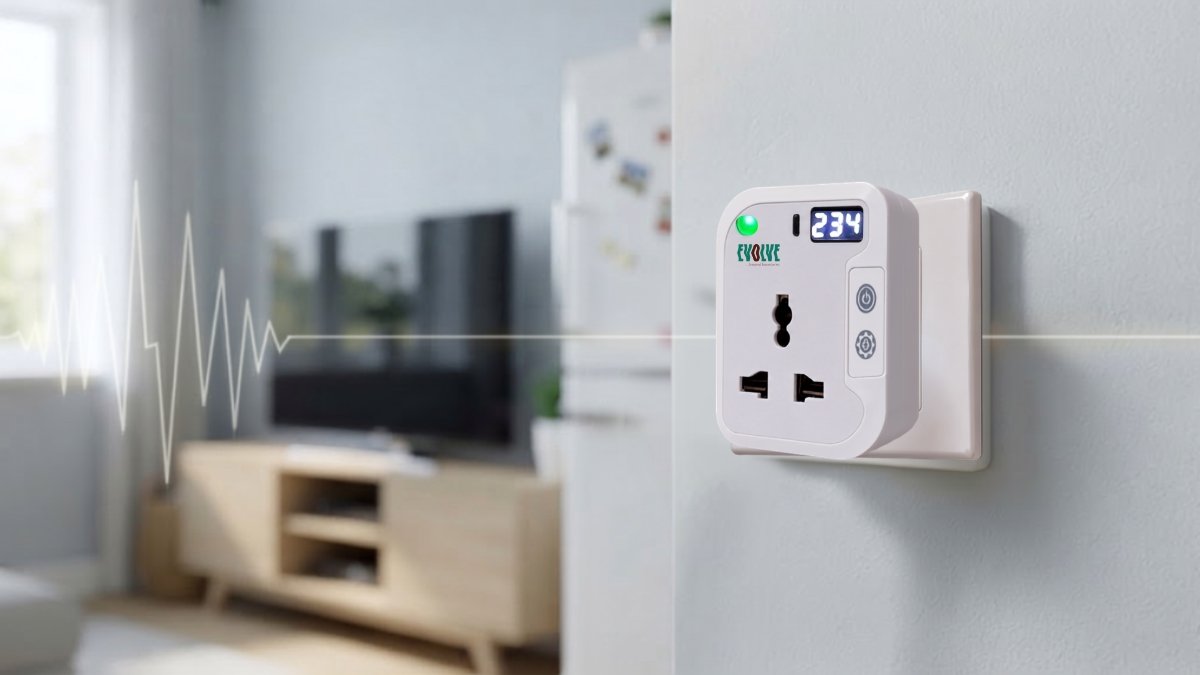
If you’ve ever watched your lights dim for no reason, heard your fridge hum a little louder than usual, or opened your laptop charger only to feel it unusually warm, you’ve already met voltage fluctuations. It’s one of those household problems that doesn’t announce itself loudly. It just quietly wears down your appliances, one spike or dip at a time, until something finally gives out and you’re left wondering why your two-year-old TV suddenly stopped working.
This is exactly the gap a power protection plug is built to close. But how does a small plastic device sitting between your wall socket and your appliance actually know when something’s wrong with the power? And more importantly, how does it stop that bad power from ever reaching your gadgets? Let’s break it down in plain language.
First, What Exactly Is a Voltage Fluctuation?
In India, the standard household supply is meant to sit around 220-230V. In the real world, though, that number moves around constantly. Heavy motors switching on nearby, transformer overloads during peak hours, lightning activity, or even something as simple as your neighborhood drawing more power in summer can push voltage up or down.
A few common types of fluctuation:
- Overvoltage – supply climbs well above the safe range, often during load-shedding recovery or grid switching.
- Undervoltage (brownout) – supply drops below normal, common during peak evening hours or in rural and semi-urban areas.
- Surges and spikes – short, sudden jumps in voltage, frequently caused by lightning strikes or heavy machinery switching off nearby.
- Frequency and load irregularities – less talked about, but they still stress sensitive electronics over time.
None of these are things you can see with the naked eye. Your appliance is either silently absorbing the damage or, if you’re lucky, tripping a fuse before things get worse.
How Does a Power Protection Plug Actually “Detect” This?
This is where the internal electronics of a device like the Evolve AP 105 come in. Instead of waiting for something to go wrong at the appliance level, the plug sits at the very first point of contact, the wall socket, and continuously reads the incoming voltage in real time.
Here’s roughly what happens inside:
- Continuous voltage sensing. The internal circuitry monitors the live supply every fraction of a second, comparing it against a safe operating range.
- Threshold comparison. The moment the reading moves outside the acceptable window- too high, too low, or an abrupt spike- the built-in controller flags it instantly.
- Instant cutoff. Rather than letting that abnormal power pass through to your appliance, the plug interrupts the circuit. Your device simply stops receiving power for a moment, which is far safer than letting it receive the wrong power.
- Restart delay. Once the plug senses the supply has stabilized and stayed steady for a set period, it reconnects the power automatically. This delay matters a lot; it stops your compressor-based appliances like fridges and ACs from restarting the second voltage looks “okay,” which is often when a second spike is most likely to happen.
- Visual status indication. LED indicators show you exactly what’s happening: normal supply, a detected fault, or overload, so you’re never left guessing why an appliance isn’t turning on.
This entire detect-and-cut sequence typically happens faster than you can blink, long before the abnormal voltage has any real chance to reach the sensitive components inside your appliance.
Why This Matters More Than People Realize
A lot of people assume their appliances are already protected because they have some kind of internal fuse or stabilizer built in. In reality, most home electronics- TVs, refrigerators, routers, computers, small industrial equipment- are designed for a narrow voltage band. Anything outside that band doesn’t always trip a fuse cleanly; sometimes it just quietly stresses capacitors and circuit boards until they degrade.
A dedicated power protection plug acts as a first line of defense specifically for this. It doesn’t try to regulate or correct the voltage like a stabilizer does; it simply refuses to pass on unsafe power in the first place. That distinction is important: prevention rather than correction, which means less wear on your appliance’s internal components over its lifetime.
Real-world feedback from users backs this up too. One AP 105 user in Madurai described the plug switching to a red indicator the moment it sensed a sudden spike, cutting power before it could reach the connected devices. Another user in Chennai shared how, during repeated voltage swings at their office, the plug kept the connected system off until the supply had genuinely stabilized, and only then allowed a safe restart, protecting the system from the kind of rapid on-off cycling that damages electronics the most.
What to Look for in a Good Power Protection Plug
If you’re considering one for your home or office, a few practical things are worth checking:
- Wide voltage range coverage – a plug that only handles minor fluctuations won’t help much during a real spike or brownout.
- Restart delay function – this protects compressor-based appliances specifically.
- Clear indicators – you should be able to tell at a glance whether the supply is normal, faulty, or overloaded.
- Plug-and-play design – no electrician or wiring changes should be needed.
- Build quality – devices exposed to Indian summers and humid coastal climates need decent temperature and moisture tolerance.
The Evolve AP 105, for instance, is built for a 110-600V range, includes surge and spike protection, works across a -5°C to 50°C temperature band, and comes with a universal socket so it fits most Indian appliances without adapters.
The Bottom Line
Voltage fluctuations aren’t rare events reserved for stormy nights; they happen more often than most of us notice, and they add up in ways that shorten the life of our appliances. A power protection plug doesn’t try to fix the electricity coming into your home; it simply stands guard, watching the supply constantly, and refusing to let anything unsafe through to your TV, fridge, computer, or office equipment.
It’s a small, inexpensive habit change: plug it in once, and it quietly does its job in the background, appliance after appliance, fluctuation after fluctuation.